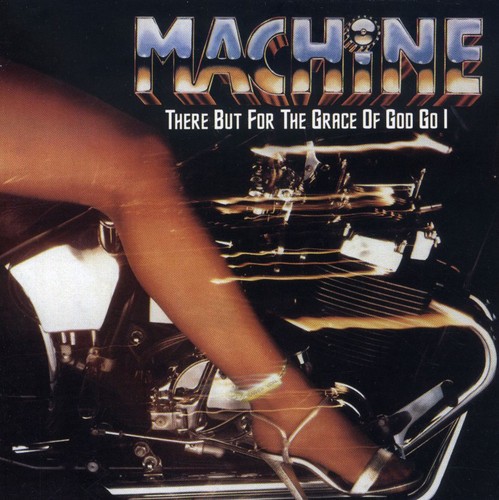
[ Video] Machine . . . There But for the Grace of God, There Go I


#KidCreole #Machine #AugustDarnell #Disco 


Machine was an American funk-disco group, formed by August Darnell in 1977. The group is most remembered today for their 1979 disco hit, "There But for the Grace of God Go I". The group disbanded in the early 1980s, and Darnell went on to form Kid Creole and the Coconuts.


______________________________________________________________
Lyrics 

Carlos and Carmen Vidal just had a child
A lovely girl with a crooked smile
Now they gotta split 'cause the Bronx ain't fit
For a kid to grow up in
Let's find a place they say, somewhere far away
With no blacks, no Jews and no gays

Chorus:
There but for the grace of God go I

Poppy and the family left the dirty streets
To find a quiet place overseas
And year after year the kid has to hear
The do's the don'ts and the dears
And when she's ten years old she digs that rock 'n' roll
But Poppy bans it from home

Chorus

Baby, she turns out to be a natural freak
Popping pills and smoking weed
And when she's sweet sixteen she packs her things and leaves
With a man she met on the street
Carmen starts to bawl, bangs her head to the wall
Too much love is worse than none at all

Chorus
____________________________________________________________
Albums
Machine (1979)
Moving On (1980)

Singles
"There But For the Grace of God Go I" (RCA Victor, 1979) (Billboard Hot 100 #77, Billboard Hot R&B/Hip-Hop Songs #91, Billboard Hot Dance Club Play #8)
"Is It Love" / "I Finally Found" (RCA Victor, 1980) (Billboard Hot Dance Club Play #27)
"Power and Reason" / "Thunder, Lightning, and Rain" (RCA, 1980)

Comments

Popular posts from this blog

4 Strategies for practicing Radical Self-Acceptance

Radical Self-Acceptance Painting by Jennifer Mazzucco #mindfulness #self-judgment #RadicalSelfAcceptance #negativethinkingpatterns #thoughts Radical acceptance involves acknowledging how life unfolds without resistance, even if we don't like things at any given moment. It can take effort to apply this principle. How can we begin to accept our situation and ourselves despite experiencing anxiety, uncertainty, and fear? Why self-acceptance is not the same as complacency. It is essential now, more than ever, to practice radical self-acceptance. This means training ourselves to find inner stability despite unpredictable external circumstances. Ultimately, we are responsible for acknowledging our hidden wounds, which can lead to personal and collective growth. Radical self-acceptance is the opposite of avoiding responsibility or giving up in self-defeat. It requires pushing against old ways of being to open the door to deep healing. Embracing radical self-acceptance allows us to int...

"Love is a combination of six ingredients: care, commitment, knowledge, responsibility, respect and trust". Bell Hooks

#AfricanAmerican #BellHooks #Love #Respect  #WhereWeStand  #ClassMatters  "Love is a combination of six ingredients: care, commitment, knowledge, responsibility, respect and trust". Bell Hooks A writer, teacher and cultural critic, bell hooks is best known for her work examining systems of domination, especially racism and patriarchy, and how they may be overcome. She has published more than twenty books, including  Talking Back: Thinking Feminist, Thinking Black; Killing Rage: Ending Racism , and  Where We Stand: Class Matters . hooks says that uncovering and naming the forms of oppression in our society is an extension of her lifelong curiosity about love and her desire to see love manifested. “Perhaps the most common false assumption about love is that it means we will not be challenged or changed,” she once wrote in the Buddhist magazine   Shambhala Sun . “When I write provocative social and cultural criticism that causes readers to stretch the...

On its 40th anniversary, a look at how 'The Wiz' forever changed black culture

#TheWiz #DianaRoss #LenaHorne #MichaelJackson #QuincyJones #SidneyLumet #StephanieMills Forty years after its original release, no film has uniquely defined black culture and shaped the framework of a musical genre quite like “The Wiz.” An adaptation of the groundbreaking Broadway musical — itself a retelling of L. Frank Baum's classic 1900 children's fantasy “The Wonderful Wizard of Oz” that became the beloved Judy Garland movie — the Sidney Lumet-directed film had a rapturous soundtrack produced by Quincy Jones, a cast that included Diana Ross, Michael Jackson, Lena Horne, Nipsey Russell, Mabel King and Richard Pryor and an aesthetic firmly rooted in black culture. For a generation of black Americans, this was the first time they saw people who spoke, sung and moved the way they did in a Broadway production and, later, a big-screen musical, and it has become a kind of rite of passage for the black community. Everyone remembers their first time experiencing “The Wiz.” I...

"Home" from the last act of the "The Wiz"

      From the last act of the "The Wiz" soundtrack   Home Suddenly, My World Has Changed its Face But I still know where I'm going I have had my mind spun around in space And yet, I've watched it growing If you're listening God Please don't make it hard to know If we should believe in the things that we see Tell us, should we run away Should we try and stay Or would it be better just to let things be? Living here, in this brand-new world Might be a fantasy But it taught me to love So it's real, real to me And I've learned That we must look inside our hearts To find a world full of love Like yours Like mine Like home #TheWiz,#LenaHorne,#StephanieMills,#MichaelJackson,#QuincyJones,#DianaRoss,#SidneyLumet,#home CREDITS: TM & © Universal (1978) Cast: Diana Ross Director: Sidney Lumet Producers: Rob Cohen, Kenneth Harper, Burtt Harris, Berry Gordy Screenwriters: L. Frank Baum, William F. Brown, Joel Schumacher