
Paul McCartney says he saw God during psychedelic trip


#Beatles  #GOD  #LSD  #Hallucination  #PaulMcCartney

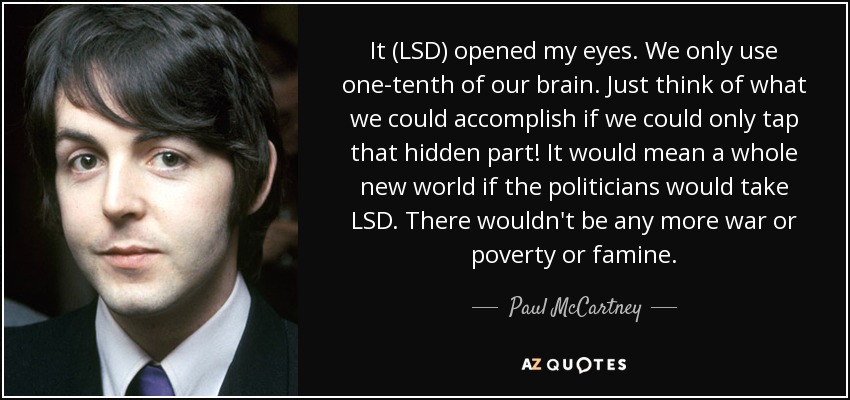
LONDON — Former Beatle Paul McCartney has told a British newspaper he believes he once saw God during a psychedelic trip.

The 76-year-old star told The Sunday Times he was “humbled” by the experience.

He said that “it was huge. A massive wall that I couldn’t see the top of, and I was at the bottom. And anybody else would say it’s just the drug, the hallucination, but we felt we had seen a higher thing.”

The Beatles’ music was heavily influenced by psychedelic drugs in the band’s final years.


McCartney also spoke of allowing himself to believe that his lost loved ones, including his late wife Linda, are “looking down” on him.

The singer is promoting a new album and a tour. He remains one of music’s most popular concert acts.

By Associated Press, September 2, 2018 

Comments

Popular posts from this blog

Are we really listening to what MLK had to say?

#MartinLutherKingJr #MLK #CivilRights #DrKing In 2020, the Martin Luther King Jr. holiday falls in a national election year, one that reminds us of the importance of voting rights, citizenship and political activism to the health of our democracy. King imagined America as a "beloved community" capable of defeating what he characterized as the triple threats of racism, militarism and materialism. The passage of the 1964 Civil Rights Act and the 1965 Voting Rights Act, alongside the 1954 Brown Supreme Court decision, represents the crown jewels of the civil rights movement's heroic period. Yet King quickly realized that policy transformations alone, including the right to vote, would be insufficient in realizing his goal of institutionalizing radical black citizenship toward the creation of the "beloved community." King argued that justice was what love looked like in public. 2020 also marks the 55th anniversary of the passage of the Voting...

Coping With Moods: The Challenge of the Turbulent Mind

#Mood #Impulses #selfregulate #selfsoothe  #Triple5LightTherapy #BlackMaleTherapist #Psychotherapy The power of moods and impulses can be overwhelming, but we can learn to self-regulate and self-soothe through awareness practices like meditation and mindfulness. By developing a healthy dialogue with our emotional nature, we can access deeper parts of ourselves and become more resilient in the face of stress and pressure. Rather than being swept away by our ever-shifting moods, we can learn to pause and reflect before acting. by Gillian McCann, Ph.D., and Gitte Bechsgaard, RP

Daylight saving time begins soon: when do we change the clocks?

#Daylightsavingtime #March8 Since the winter solstice on Dec. 21, 2019, the nights have been getting shorter, and the days are longer. So, when do we change the clocks? Daylight saving time (often erroneously said as daylight savings time) begins Sunday, March 8, 2020. via GIPHY That Sunday, the clocks will spring forward, causing areas that practice daylight saving time to lose an hour (don't worry, the hour is gained back in the fall). When the clock strikes 2 a.m., the time will change to be 3 a.m. via GIPHY Most of the United States practices daylight saving time,  much to the disdain of lawmakers including  Lancaster County Sen. Scott Martin (R-Martic Township). Arizona is the only state that refrains from practicing daylight saving due to the summertime heat. The residents of Arizona prefer their cooler nights as a break from the harsh temperatures,  according to the National Geographic. The amount of sunlight ...

A call for equality and freedom, it became one of the defining moments of the civil rights movement

       #MLK #MartinLutherKingJr #IHaveaDream I Have a Dream, speech by Martin Luther King, Jr., that was delivered on August 28, 1963, during the March on Washington. A call for equality and freedom, it became one of the defining moments of the civil rights movement and one of the most iconic speeches in American history. Some 250,000 people gathered at the Lincoln Memorial in Washington, D.C., for the March on Washington. The one-day event both protested racial discrimination and encouraged the passage of civil rights legislation; at the time, the Civil Rights Act was being discussed in Congress. The march featured various speeches as well as musical performances before King, a celebrated orator, appeared as the final official speaker; A. Philip Randolph and Benjamin Mays ended the proceedings with a pledge and a benediction, respectively. Early in his prepared speech, King referenced Abraham Lincoln’s Gettysburg Address with “Five score years ago….” He then spoke a...