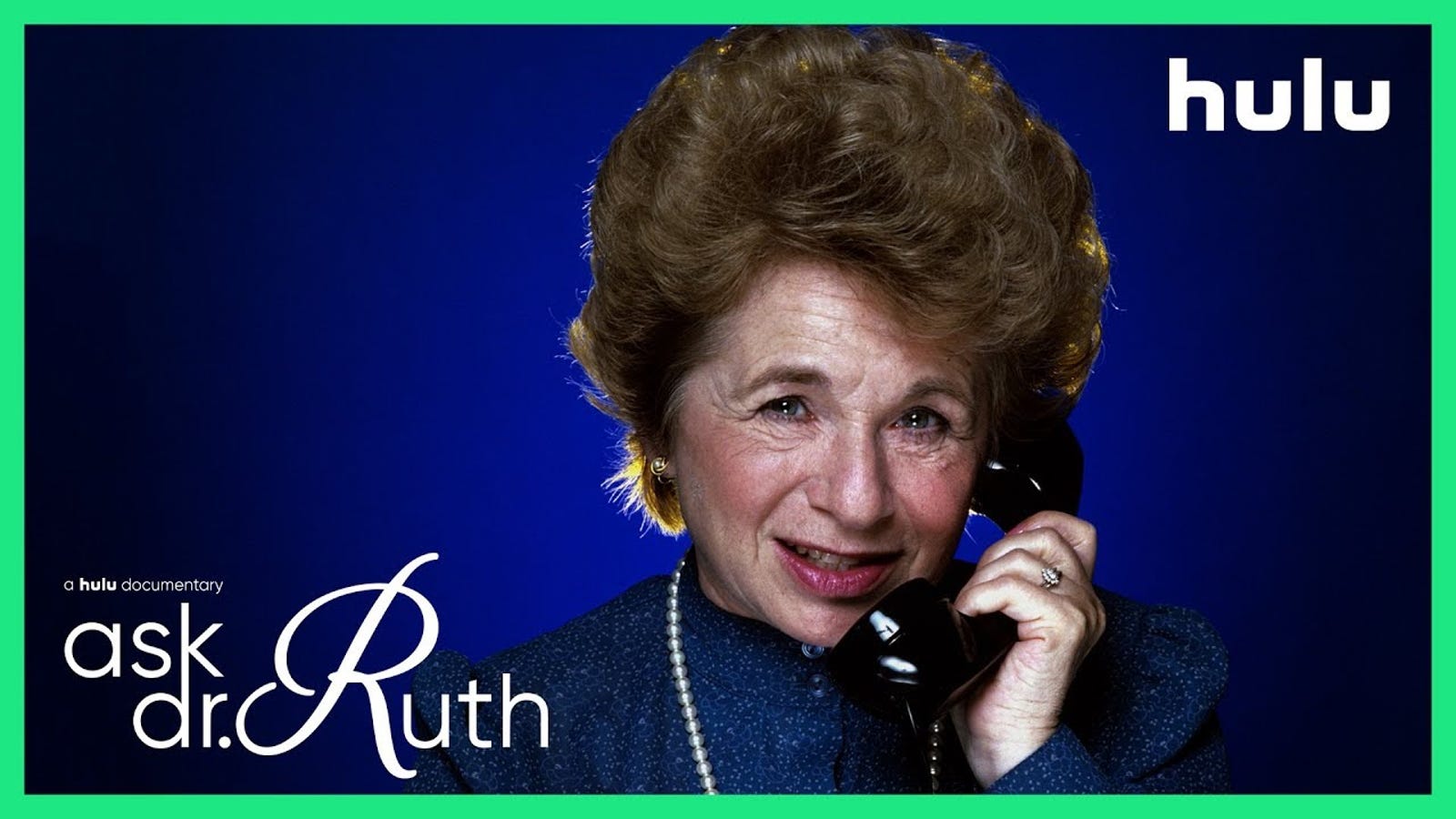
Beloved Sex Educator Dr. Ruth Westheimer Is Getting Her Own Documentary [trailer]


This may be hard to imagine in these dick-laden times, but not very long ago it was rare to even hear someone say the word “penis” on television, much less get an eyeful of one. To quote Lindsay Lohan: Oh, the story changes.


As a sex educator with her own show and inimitable presence in pop culture, Dr. Ruth Westheimer was one of the few reliable “penis”/“vagina”-sayers on television in the ’80s. Thank god for her then, thank god for her now. She’s 90! She fled the Holocaust! And, like Joan Rivers, Carol Channing, Olympia Dukakis, etc., she’s hit that win/win milestone of being immortalized in a biographical documentary that we all get to enjoy.

Ask Dr. Ruth is set to premiere in a few weeks at the Sundance Film Festival and will stream on Hulu later this year. Ryan White, best known for directing/producing Netflix’s The Keepers, directed it and the trailer is above. “I have an obligation to live large and make a dent in this world,” she says. “At 90, still talking about sex, from morning to night.”

By Rich Juzwiak

Comments

Popular posts from this blog

Are we really listening to what MLK had to say?

#MartinLutherKingJr #MLK #CivilRights #DrKing In 2020, the Martin Luther King Jr. holiday falls in a national election year, one that reminds us of the importance of voting rights, citizenship and political activism to the health of our democracy. King imagined America as a "beloved community" capable of defeating what he characterized as the triple threats of racism, militarism and materialism. The passage of the 1964 Civil Rights Act and the 1965 Voting Rights Act, alongside the 1954 Brown Supreme Court decision, represents the crown jewels of the civil rights movement's heroic period. Yet King quickly realized that policy transformations alone, including the right to vote, would be insufficient in realizing his goal of institutionalizing radical black citizenship toward the creation of the "beloved community." King argued that justice was what love looked like in public. 2020 also marks the 55th anniversary of the passage of the Voting...

A Single Dose of CBD Reset the Brains of People at High Risk of Psychosis

#CBD #Psychosis #MentalHealth #Medicine #Neuroscience #Psychology #Weed P sychosis, a severe mental disorder characterized by a loss of grip on reality,  can include unsettling hallucinations and delusions . As no one’s been able to pin down a single cause of psychosis, it’s been even harder to pin down a treatment. But researchers behind a new JAMA Psychiatry study seem to be on the right track. In the study, they report that they’ve found a way to reset the psychosis-afflicted brain using an unlikely plant: marijuana. Researchers are increasingly finding evidence that the  active components  of marijuana can help ease symptoms in people with  epileptic seizures ,  chronic pain , and  post-traumatic stress disorder , but there’s much to be learned about its relationship to psychosis. The most well-known  cannabinoid  Δ⁹-tetrahydrocannabinol — better known as THC — has  previously been linked  to the development of psychosis...

Coping With Moods: The Challenge of the Turbulent Mind

#Mood #Impulses #selfregulate #selfsoothe  #Triple5LightTherapy #BlackMaleTherapist #Psychotherapy The power of moods and impulses can be overwhelming, but we can learn to self-regulate and self-soothe through awareness practices like meditation and mindfulness. By developing a healthy dialogue with our emotional nature, we can access deeper parts of ourselves and become more resilient in the face of stress and pressure. Rather than being swept away by our ever-shifting moods, we can learn to pause and reflect before acting. by Gillian McCann, Ph.D., and Gitte Bechsgaard, RP

4 Strategies for practicing Radical Self-Acceptance

Radical Self-Acceptance Painting by Jennifer Mazzucco #mindfulness #self-judgment #RadicalSelfAcceptance #negativethinkingpatterns #thoughts Radical acceptance involves acknowledging how life unfolds without resistance, even if we don't like things at any given moment. It can take effort to apply this principle. How can we begin to accept our situation and ourselves despite experiencing anxiety, uncertainty, and fear? Why self-acceptance is not the same as complacency. It is essential now, more than ever, to practice radical self-acceptance. This means training ourselves to find inner stability despite unpredictable external circumstances. Ultimately, we are responsible for acknowledging our hidden wounds, which can lead to personal and collective growth. Radical self-acceptance is the opposite of avoiding responsibility or giving up in self-defeat. It requires pushing against old ways of being to open the door to deep healing. Embracing radical self-acceptance allows us to int...